The walk sold here
A guided medina walk
The walk sold on this site
- Length4 hours
- Reviews7,084 at 4.72
- From$17
Help me decide
Two questions, one plan
Say what you want from the city and the tour that fits appears with its starting price.
The one for you
from $17
A walk of 4 hours with a live guide in English or French, help at the ticket line and the classic stops.
The one for you
from $28
A walk of 3 hours with a local guide, with optional stops at Jemaa el-Fna, the Mellah, the Kasbah and Souk Semmarine.
The one for you
from $16
A private tour of 1 to 3 hours with pickup included and stops at Jemaa el-Fna, the Koutoubia, the Bahia Palace and the Ben Youssef Madrasa.
The one for you
from $32
A tour of 3 hours with a guide, with a small group limited to 6 participants.
An honest look at the medina: what you get, what wears visitors down, who will love it, who should choose another city, and how to see it with little walking.
Editorial team, marrakechmedinatour.click · Updated November 23, 2026 · ~7 min read
In brief
UNESCO describes the 700 hectares of the Marrakech medina as a living historic town with its tangle of lanes, houses, souks, fondouks and traditional trades.1 That is the first thing Marrakech gives: a place where people still live and work inside old walls, and where a morning walk crosses a palace, a tomb, a trade lane and a square. The national tourism office describes the medina as the city's most historic and most visited quarter.6
The second thing is food. The national tourism office calls tanjia the staple dish of Marrakech and describes Jemaa el-Fna as a giant open-air restaurant at night, serving harira, dates and honey sweets among other dishes.7,8 The third is the square itself: by day the tourism council finds it an ordinary square, and from late afternoon it fills with people.2
A fourth reason is access. A guided walk of the medina starts from $17, lasts 4 hours and ends in the same square where it begins. A visit does not need a long itinerary or a large budget to deliver the main sights, and the monument tickets, paid on the spot, are the only fixed costs on top of the guide.
Side by side
| City | Days to allow | Setting | Best months |
|---|---|---|---|
| Marrakech | 3 days5 | Imperial city, car-free medina19,20 | March to May, September to November12 |
| Fez | 3 days16 | Imperial city, UNESCO-recognized medina21 | Not given in our sources |
| Essaouira | 2 days17 | Coastal medina, UNESCO since 200122 | Not given in our sources |
| Chefchaouen | 2 days18 | Mountainside city, blue houses23 | April to June, September to October18 |
Figures from the national tourism office destination pages; we state no other measure of one city against another.5
Heat comes first. The Marrakech tourism council puts winter midday temperatures at 20 to 25 C and says summer afternoons can climb to 45 C or more.3 The best time to go, says the national tourism office, is spring from March to May or autumn from September to November; summers are very hot, and winter brings mild days and cool evenings.12 A summer visit is possible, but plan the lanes for the cooler hours.
Hassle comes second. UK advice calls petty crime common in the medina quarters and says people posing as official tourist guides often harass tourists.4,13 Australian advice adds that intimidation is sometimes used to push customers into buying.14 That is the cost of a busy medina, and a booked guide handles most of it.
Crowds and queues come third. The sold listing says that during peak season monuments can be crowded and that queues may remain inside, especially at the Saadian Tombs. Ramadan shifts the rhythm of the city too: UK advice says that eating, drinking, smoking or chewing gum in public during the day may cause offence.15
Marrakech suits a first visit to Morocco, because many of the main sights sit inside the medina and a short stay covers a lot. The national tourism office suggests 3 days: the medina, the souks and Jemaa el-Fna first, and afterwards the Majorelle Garden with the El Badi Palace and the Koutoubia.5 A long weekend fits that plan, and the day trips run from 45 minutes to 2.5 hours.24
It suits food lovers, since the dishes are part of the city and a food walk starts from $28. It suits people who like markets and crafts, because the souks are grouped by trade: Souk Semmarine and Rahba Qedima, pottery at the Souk Zrabi, babouche slippers at the Souk Smata; a guide can explain which lane is which on the first morning.9,10,11,25
It suits travellers who accept a guide for the first morning. A 4-hour walk that strings together the Koutoubia, the royal tombs, the former Jewish quarter, the palace and the souks turns an overwhelming layout into a map you can use alone the next day. That is what a first-time visitor gets for the fare, besides the stories.
Ways in
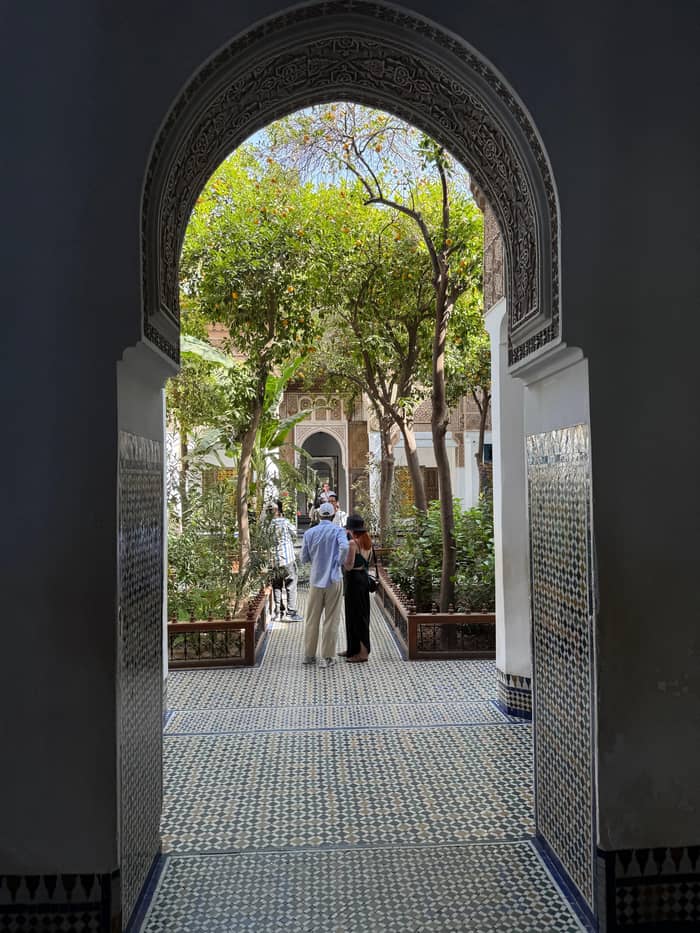
The walk sold here
The walk sold on this site
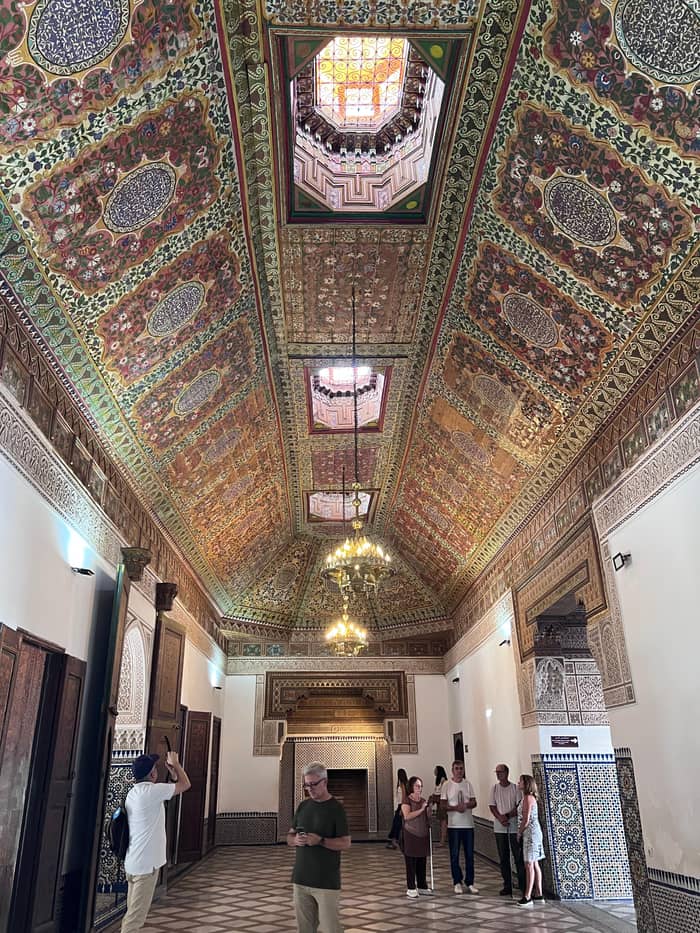
Minimal walking
Little walking
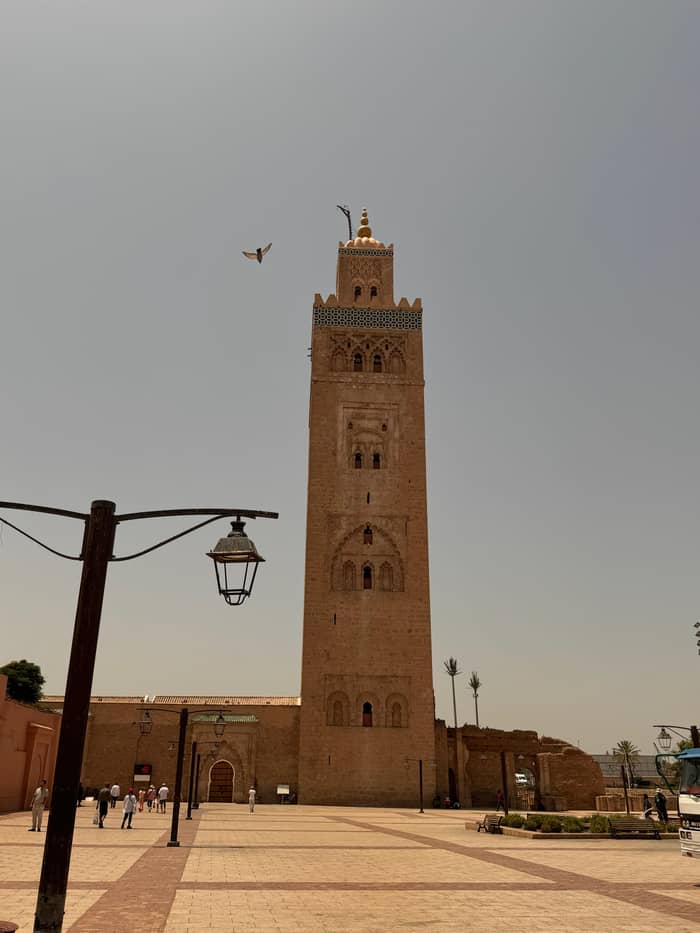
Evenings
Eat your way through it
Marrakech is not for everyone. If you want quiet streets, an unhurried pace and no shop pressure, a coastal town or a mountain village may be a better match. The national tourism office describes Essaouira as a coastal medina with a port and a fortress, and Chefchaouen as a mountainside city of blue houses.17,23
If you dislike heat, avoid a summer midday visit, or choose a spring or autumn week. If you find bargaining tiring, book guided walks and fixed-price experiences, and let the guide handle the souks. If you travel with someone who cannot walk far, read the section below on options with minimal walking before you decide.
If you have only a day in Morocco, Marrakech is still possible, but the day will be a sprint. A guided walk takes 4 hours and a food walk takes about 3, which leaves little time for the Majorelle Garden or a hammam. Better to give the city 3 days, as the national tourism office advises, or choose a smaller place for a single day.5
One day
Morning
The sold walk lasts 4 hours and begins in front of Cafe de France.
Midday
Summer afternoons can be fiercely hot, up to 45 C or more.3
Afternoon
The council names Souk Semmarine, Rahba Qedima and the Souk Zrabi among the lanes.9,10,11
Dusk
The square starts to fill with people late in the afternoon.2
Evening
A street food walk starts from $28 and lasts 3 hours.
The national tourism office gives each destination a length of stay. It advises 3 days for Marrakech and for Fez, and 2 days for Essaouira and for Chefchaouen.5,16,17,18 Fez is an imperial city whose medina UNESCO recognizes as of outstanding universal value, and Marrakech and Essaouira are World Heritage medinas too.21,6,22
The settings differ. Marrakech is an imperial city with a walled, car-free medina, Fez is also an imperial city, Essaouira is a coastal medina about 2 hours 30 minutes from Marrakech by the tourism office's figure, and Chefchaouen is built on a mountainside with blue-washed houses.19,17,23 The same office lists Rabat, Fez, Meknes and Marrakech as the four imperial cities.19
The best months are given for only two of these. For Chefchaouen the office names April to June and September to October, and for Marrakech the same spring and autumn windows as above, while the pages we use state no months for Fez or Essaouira, so we give none.12,18 Pick Marrakech for the size and the food, Fez for a deeper old city, Essaouira for the sea and Chefchaouen for hills and colour.
Video
Fit Nomads on YouTube · Video data is requested only when you tap play.
The best time to go is March to May and September to November. Summer is very hot; winter days are mild and evenings cool.
Before you decide
If you only have a day, here is what to do in the medina Marrakech visitors find easiest. Start early with the guided walk: 10 minutes at the Koutoubia, 15 at each of Bab Agnaou and the Kasbah, 40 at the Saadian Tombs, 15 in the Mellah, 45 at the Bahia Palace and 40 in the souks, finishing at Cafe de France. Pay the tickets in cash.
Eat lunch in the lanes, away from the busiest square, and rest through the hottest hours; in summer the afternoons reach 45 C or more.3 The tourism council's own ideas for rounding off a stay are a hammam, a night in a riad and a rooftop drink around the square, and they double as a rest, with time to read, write postcards or sit in a shaded courtyard.28
Return to the square near dusk. The tourism council says it fills with people as the afternoon ends, and the national tourism office says it becomes an open-air theatre once night falls.2,29 A food walk can end the day, with options from $28 for 3 hours. Leave the rest for another day, and do not try to fit the whole city into a single evening.
If you need a Marrakech day tour with minimal walking, there are options, though the medina is car-free and some walking is unavoidable.20 The national tourism office mentions a sightseeing bus for moving around Marrakech, and a carriage ride for the alleys.26,27 Two guided options take you through the city without walking all of it.
For a tuk tuk, a private ride of 1 to 3 hours, pickup included, starts from $16, and the listing names the Ben Youssef Madrasa, the Bahia Palace, the Koutoubia and Jemaa el-Fna as its stops. An electric bicycle tour of 3 hours costs from $32 and limits the group to 6 participants. Neither replaces the walk inside a monument, but both cover distance.
Several guided walks carry a wheelchair accessible label, among them the Ben Youssef and Secret Garden walk and the palace, museum, madrasa and medina walk from $17, while another palace and tombs listing warns that the alleys may not suit wheelchair users. Ask the provider what the label means for your own needs.
FAQ
It suggests 3 days: the old city with its markets and its square, then the Majorelle Garden and the Koutoubia.5
Spring and autumn are the months the national tourism office likes, and summers are very hot.12
Summer afternoons can climb to 45 C or more, the tourism council says, while winter midday temperatures sit at 20 to 25 C.3
A tuk tuk tour starts from $16 and an electric bicycle tour from $32.
Sources
Walking the Marrakech medina? A real person answers here.