The sold walk
Monuments and souks walk
The Koutoubia to the Medina
- Length4 hours
- GuidesEnglish and French
- Pricefrom $17
Where is your stop
Browse 23 stops
Select a route, then tap a marker or stop to see its note and open Google Maps.
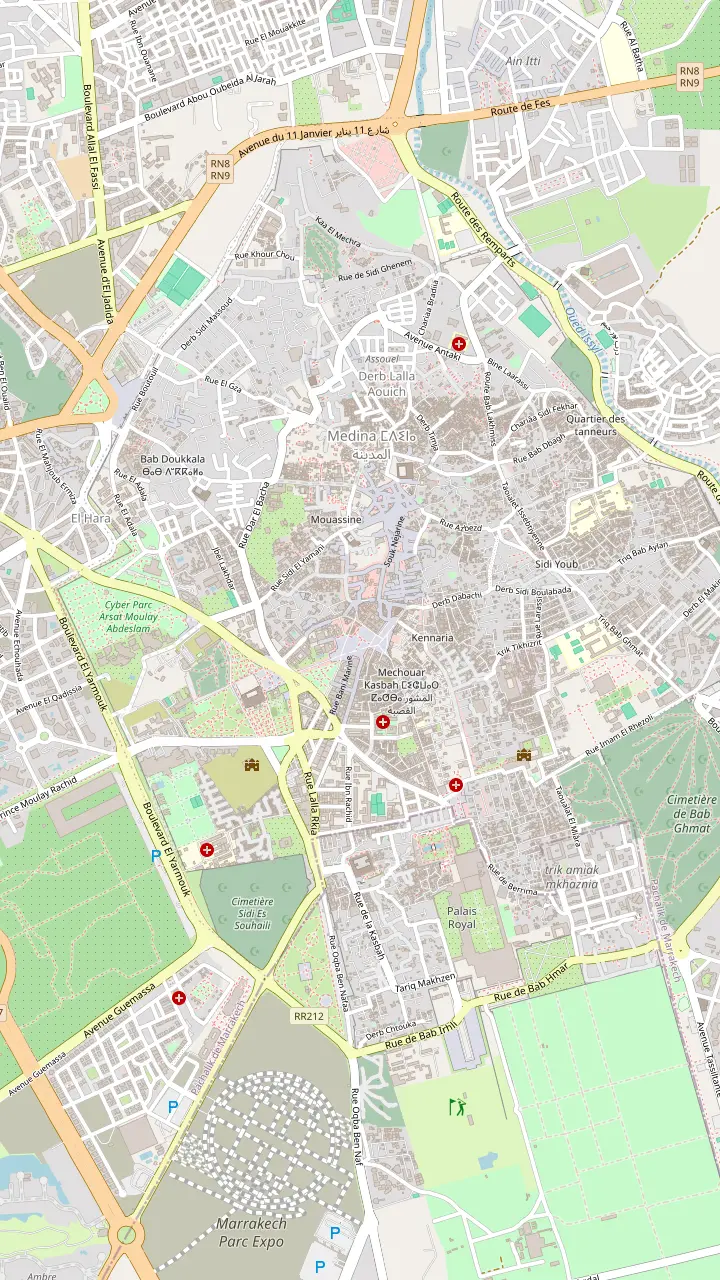
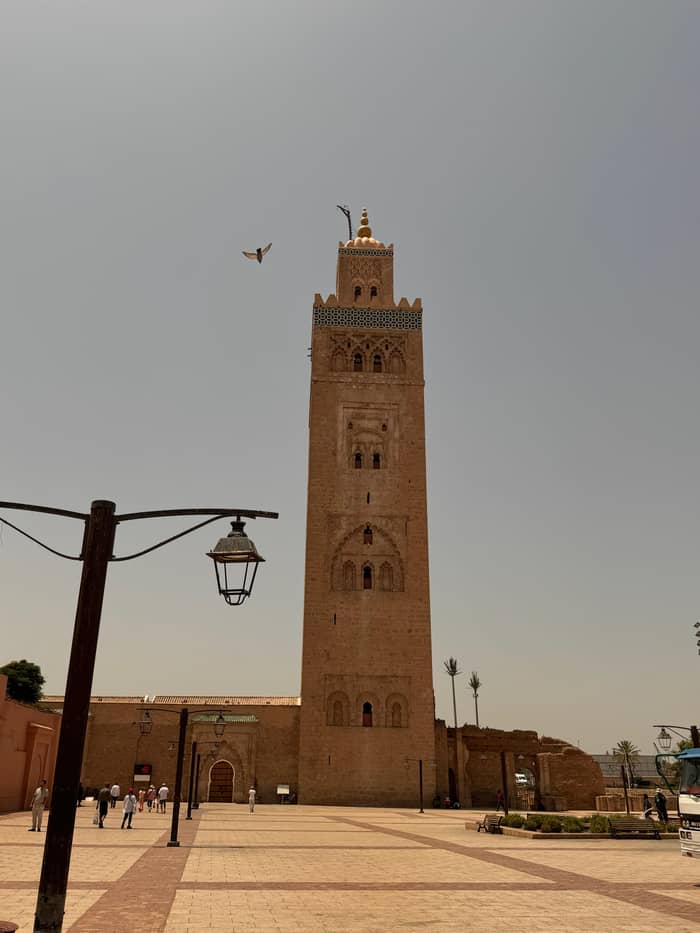
The Koutoubia was inaugurated in 1157 and its stone minaret stands 77 m high; the sold tour views it from the outside only.
Google MapsA triangular square at the entrance of the Medina, ringed by restaurants and stands, with services and performances that go on well into the night.
Google MapsThe regional tourism council calls Souk Semmarine the beating heart of the souks.
Google MapsThe madrasa dates from the 16th century and had 130 student rooms around a courtyard.
Google MapsA Saadian-era monument with two green spaces, at Rue Mouassine 121 in the medina.
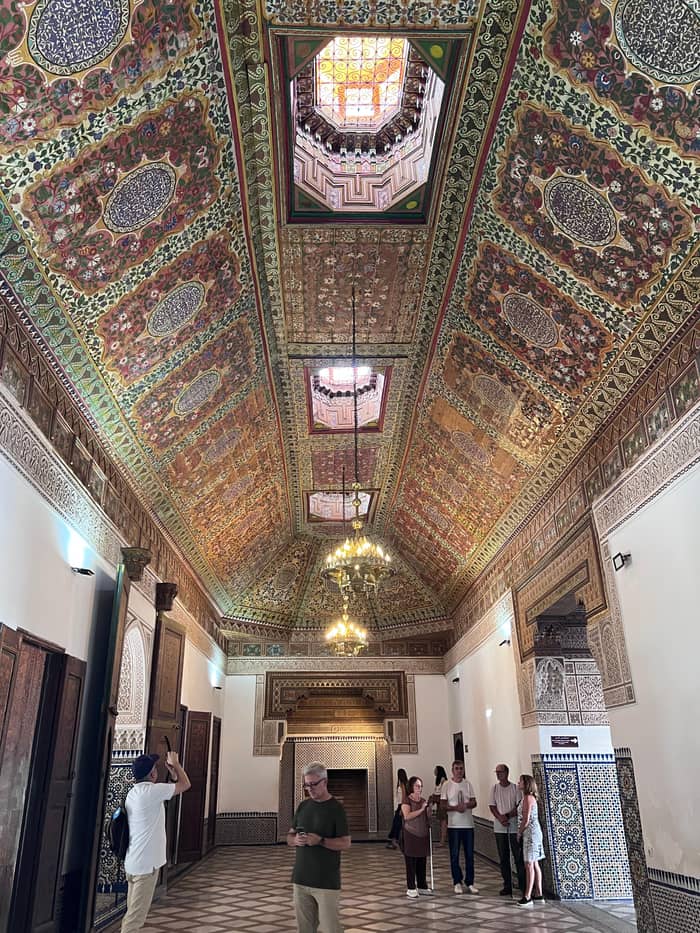
Google MapsArtisans worked on the Bahia Palace for fourteen years, and the sold tour gives it 45 minutes.
Google MapsThe mellah was built in 1558 and lies south of the medina, near the Bahia Palace.
Google MapsThe gate beside the tannery where raw hides arrive, before they are sold at Souk Ejjeld.
Google MapsA gate on the northwest side of the medina, inside ramparts of some 19 kilometers.
Google MapsOne of the monumental gates of the ramparts, and a 15-minute stop on the sold tour.
Google Maps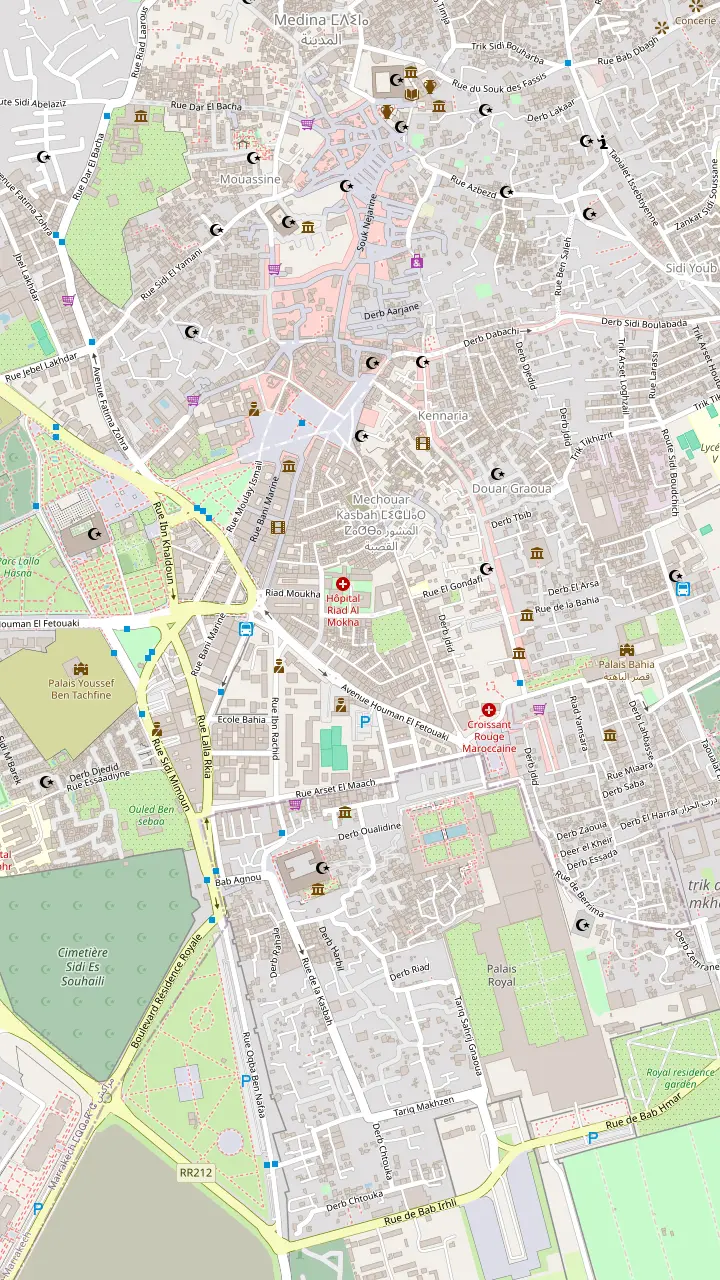
The Koutoubia was inaugurated in 1157 and its stone minaret stands 77 m high; the sold tour views it from the outside only.
Google MapsOne of the monumental gates of the ramparts, and a 15-minute stop on the sold tour.
Google MapsThe necropolis began after the burial of Prince Mohamed Cheikh in 1557, and the sold tour gives it 40 minutes.
Google MapsThe mellah was built in 1558 and lies south of the medina, near the Bahia Palace.
Google MapsArtisans worked on the Bahia Palace for fourteen years, and the sold tour gives it 45 minutes.
Google MapsA triangular square at the entrance of the Medina, ringed by restaurants and stands, with services and performances that go on well into the night.
Google MapsThe finishing point listed for the sold tour.
Google Maps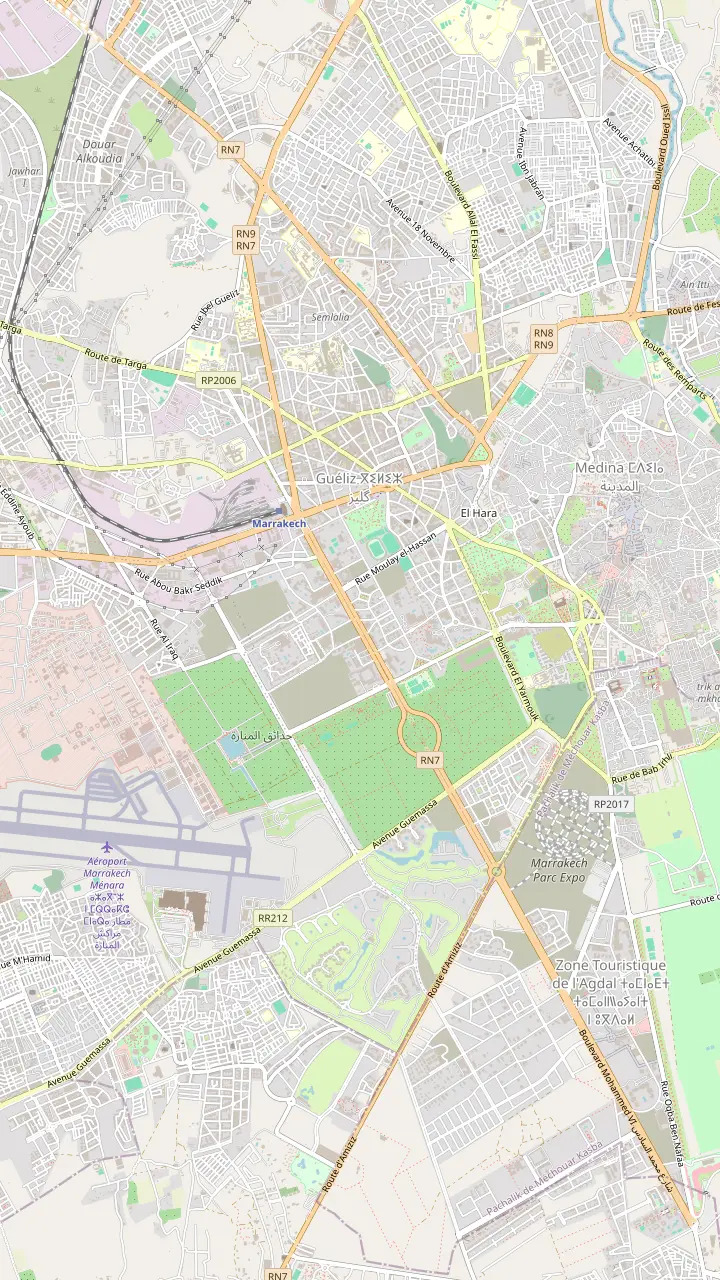
The city's airport, southwest of the medina, on the road to town.
Google MapsThe railway station sits in the Gueliz district, northwest of the medina.
Google MapsThe long-distance bus station, close to the Bab Doukkala gate on the northwest side of the medina.
Google MapsA gate on the northwest side of the medina, inside ramparts of some 19 kilometers.
Google MapsThe Koutoubia was inaugurated in 1157 and its stone minaret stands 77 m high; the sold tour views it from the outside only.
Google MapsA triangular square at the entrance of the Medina, ringed by restaurants and stands, with services and performances that go on well into the night.
Google MapsMap data by © OpenStreetMap contributors
The walled old city explained: where the ramparts run, how the souks, the mellah and the palaces fit together, where the history starts and when its monuments open.
Editorial team, marrakechmedinatour.click · Updated November 23, 2026 · ~8 min read
In brief
If you are asking what is the medina in Marrakech, the short answer is that it is the old city itself. The regional tourism council calls the medina the name of the old city of Marrakech and says that from the air it looks like a giant beehive.1 The word means city in Arabic, and across Morocco it names the historic walled quarter that grew up long before the wide modern avenues were laid out around it. In Marrakech that quarter still holds shops, workshops, mosques, houses and palaces, all packed into lanes that seldom run straight.
What makes it more than a monument is that it works. The national tourism office writes that people live and work inside its ochre walls and pass their know-how on to the next generation.2 You will see that on any walk: a baker carrying trays, a metalworker hammering in a doorway, children heading for school through the same arches that tourists photograph. Treat it as a neighborhood that welcomes visitors, not as an open-air museum, and the lanes become much easier to read.
That also explains how the city is organized. The council adds that, more than 100 years ago, the whole of Marrakech and all its trade still lay inside these walls.7 The medina was the city, so it carries every layer of it: religious buildings, trade, craft, government and homes. UNESCO frames it as a living historic town: a tangle of lanes, houses, souks, fondouks, workshops and traditional trades.3
Landmarks
| Place | What it is | What the sources add |
|---|---|---|
| Koutoubia Mosque | The landmark minaret | Inaugurated in 1157, minaret 77 m.8,16 |
| Jemaa el-Fna | The hub square | Inscribed by UNESCO in 2008.12 |
| Souk Semmarine | The main souk lane | Called the beating heart of the souks.17 |
| Ben Youssef Madrasa | A Saadian-era college | 130 student rooms in its day.18 |
| Bahia Palace | A palace of courtyards | Artisans worked on it for 14 years.19 |
| El Badii Palace | A palace in ruins | Built between 1578 and 1603.10 |
| Mellah | The Jewish quarter | Built in 1558, two entrance doors.11 |
| Saadian Tombs | A royal necropolis | Begun after the burial of 1557.9 |
Dates and figures come from the regional tourism council, UNESCO and the national tourism office, as each states them.11
The size question has two official answers, and they fit together. UNESCO speaks of the 700 hectares of the Medina,3 and the regional tourism council says ramparts of some 19 kilometers, dating from 1122, ring the medina.4 If you want to know how big is the medina in Marrakech in terms you can walk, think of an irregular ring several kilometers around, far too large to see in a single outing and large enough that a visitor can wander for a full day and still miss whole quarters.
The ramparts matter because they are the legal edge. UNESCO states that the boundary of the inscribed property is defined by the original ramparts, which enclose all the architectural and urban attributes that give it value.13 The same entry lists ramparts and monumental gates among the masterpieces of the city, next to the Koutoubia, the Saadian tombs and the Bahia Palace.14 Each gate has a name, and the gates are the easiest way to orient yourself when the lanes inside turn confusing: Bab Agnaou on the south side, Bab Doukkala toward the west, Bab Debbagh toward the east.
Bab Debbagh has a job as well as a name. According to the council, hides come in through the Bab Debbagh tannery, sell on at Souk Ejjeld and leave as finished goods.15 That one sentence shows how the medina is arranged: trades cluster in a district, the gate serves the trade, and the finished goods travel inward to the souks. Pick the gate closest to your plan and walk in from there, and keep its name in mind as your way back out.
Time on the ground
Stop times as the sold listing states them, over a tour of 4 hours: 10, 15, 15, 40, 15, 45 and 40 minutes.
UNESCO dates the foundation of Marrakesh to 1070-1072, by the Almoravids, and describes the city as capital of the Almohads from 1147 to 1269, long a leading political, economic and cultural center for the Muslim west.5 The regional tourism council places the ramparts in 1122 and dates the first sanctuary of the Koutoubia to 1157, with the minaret following a year later.4,8 These are the oldest layers you can still touch.
The next great wave comes from the Saadian rulers. Their necropolis begins with a burial in 1557, according to the council, which also dates the El Badii palace to between 1578 and 1603,9,10 puts the Ben Youssef Madrasa in the 16th century24 and places the mellah in 1558.11 If the dates seem to cluster, that is because they do: a single dynasty rebuilt much of the city in a few decades.
For the Bahia Palace the council gives a labor figure instead of a date: Moroccan and Andalusian artisans worked on it for fourteen years.19 The recent story is about care. A restoration program for the Jewish quarter began in 2014,25 and UNESCO notes that the property is vulnerable to urban development and uncontrolled alterations to the upper floors of houses.26 The square itself has carried legal protection since 1922.27
Pick your angle
Say what you want from the old city and the matching start appears.
If I want the big landmarks
The sold walk
It stops at the Koutoubia, Bab Agnaou, the Saadian Tombs and the Bahia Palace.
If I want the Jewish quarter
The mellah
It lies south of the medina near the Bahia Palace.20
If I want to see crafts being made
Souk Sebbaghine and the tannery side
Hides reach the Bab Debbagh tannery and move on to Souk Ejjeld.15
If I want a quiet green break
Le Jardin Secret
The garden dates to the Saadian dynasty and has two green spaces.21
If I want the evening atmosphere
Jemaa el-Fna
Services and performances run well into the night.22
See it with a guide
The sold walk
The Koutoubia to the Medina
Palace walk
Bahia, Mellah, Ben Youssef
Garden walk
Ben Youssef, Jardin Secret
Think of the medina as a few districts around a hub. The hub is Jemaa el-Fna, where the Medina begins, a triangle of open ground ringed by restaurants, stands and public buildings.6 North of it the souks begin, led by Souk Semmarine, with pottery, tanning, spices, perfumes and slippers each sold in a lane of their own.17,30,31,32,33 A separate page here goes deeper into buying and bargaining.
South and east of the palaces lies the mellah, the old Jewish quarter. The council says it was built in 1558 under the Saadian sovereign Moulay Abdallah, with two entrance doors, and places it south of the medina near the Bahia Palace and the Badi, reached by way of Place des Ferblantiers.11,20 It lists a spice souk, a jewelry souk, a fabric souk, the tinsmiths square and the two synagogues Neguidim and Alazma.34 The sold walking tour gives the Mellah 15 minutes, so a guided Jewish quarter walk is really a stroll with a guide who knows where to turn.
The kasbah side, to the south of the square, is where the royal sites sit. Bab Agnaou, the Kasba and the Saadian Tombs are separate stops on the sold tour, with 15, 15 and 40 minutes respectively. Near them stand the high walls of the El Badii palace, and the council notes that storks nest on them, which is an unexpected sight for anyone expecting only masonry.35 The Koutoubia, a short walk from the square, is the landmark you will see from much of the medina.
Compare the walks
Say how many are coming, then read each walk's from-price for the whole group.
Look at 3 options
Say how many are coming, then read each walk's from-price for the whole group.
≈
View≈
View≈
ViewStarting prices as on the booking platform, converted at the ECB reference rate. You see the exact price at booking.
Layer by layer
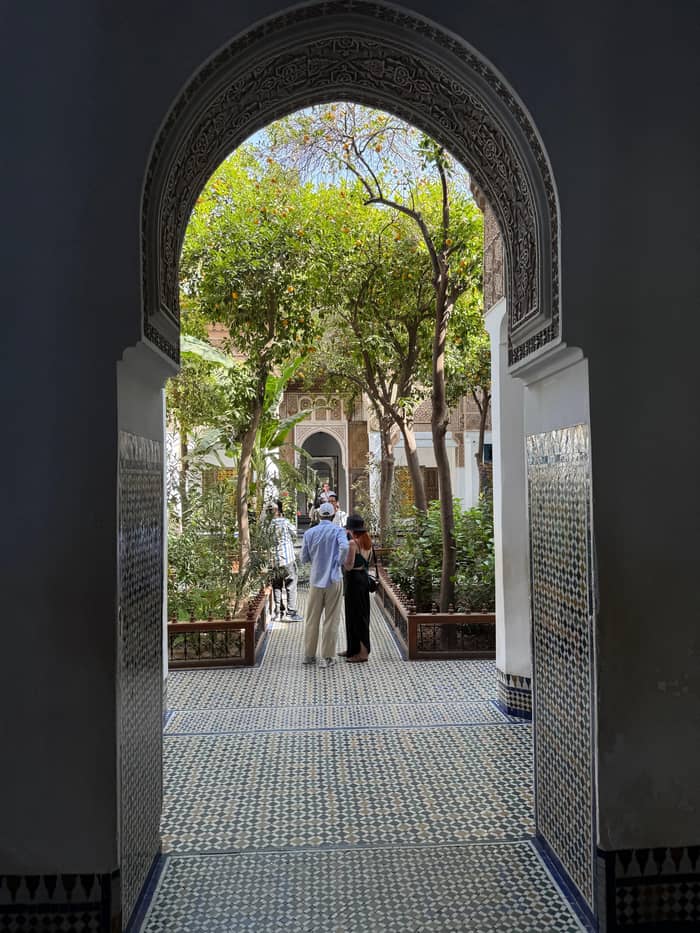
The look of the city is not accidental. Look at the doorways and the courtyards behind them. The national tourism office describes riads as small oriental palaces overlooking a patio, which explains why a blank lane so often opens onto a garden of tile,36 and it notes that zellige tiles with intricate shapes cover their walls and floors.37 The Koutoubia shows the same taste in stone and glazed bands at a much larger scale.
Crafts keep the fabric alive. UNESCO credits restoration work with reviving building trades, from zellige and wrought ironwork to painted wood and plastering.38 The national tourism office lists Marrakech among the places known for wrought iron lanterns and mirrors,39 and places most of the region's jewelry shops in the medina beside the square.40 When a guide points at a ceiling or a door and explains how it was made, this is the knowledge being passed on.
There is also green space inside the walls. Le Jardin Secret gives the medina a pair of green spaces and a Saadian-era past, at Rue Mouassine 121,21,28 and UNESCO counts the Aguedal and Menara gardens and the Palmeraie as part of the natural setting of the whole property.41 Even in a dense city the sources keep returning to courtyards, gardens and water, and a good route builds in one of them so the day does not become all lanes and noise.
Video
Hikma History on YouTube · Video data is requested only when you tap play.
The Jemaa el-Fna Square is one of the main cultural spaces in Marrakesh and has become one of the symbols of the city since its foundation
Before you walk in
Visitors often search for medina Marrakech opening hours, and the honest answer is that the medina has no single timetable in the sources used here. UNESCO describes it as a living town, and the figure that comes closest to a clock is the one for the square, where services and performances run all through the day and well into the night.22 Shops and workshops keep their own hours, which shift with the season, the day of the week and the family that runs them.
Hours are given monument by monument. A listing for a Bahia Palace entry ticket gives a daily window: doors open at 09.00, the last entry is at 16.30 and the palace closes at 17.00, with some areas possibly shut for renovation while the rest stays open. The same listing has the Culinary Art Museum opening at 09:00 and staying open to 20:00, with its last entry at 18:00. Treat these as that listing's statement and confirm on the day, since a palace can change its schedule for a season or for works.
Le Jardin Secret says on its own site that it is open every day, including weekends and public holidays, and that hours vary with the season and are kept current on its website.42,29 For the Saadian Tombs and the Ben Youssef Madrasa the sources used here give no hours, so the safest plan is to visit in the morning and check before you cross the city. A guided walk helps because the guide sets the order around what is open, and the sold tour lists the Koutoubia as a view from the outside.
FAQ
UNESCO dates the foundation to 1070-1072, by the Almoravids.5
Hours come monument by monument, and Le Jardin Secret says its own vary with the season.29
The sold listing keeps visitors outside the Koutoubia, at a viewing stop.
The national tourism office says people live and work inside its walls.2
The sold tour stops at Bab Agnaou, and the Bab Debbagh tannery receives raw hides.15
Sources
Walking the Marrakech medina? A real person answers here.